- About MAA
- Membership
- MAA Publications
- Periodicals
- Blogs
- MAA Book Series
- MAA Press (an imprint of the AMS)
- MAA Notes
- MAA Reviews
- Mathematical Communication
- Information for Libraries
- Author Resources
- Advertise with MAA
- Meetings
- Competitions
- Programs
- Communities
- MAA Sections
- SIGMAA
- MAA Connect
- Students
- MAA Awards
- Awards Booklets
- Writing Awards
- Teaching Awards
- Service Awards
- Research Awards
- Lecture Awards
- Putnam Competition Individual and Team Winners
- D. E. Shaw Group AMC 8 Awards & Certificates
- Maryam Mirzakhani AMC 10 A Awards & Certificates
- Two Sigma AMC 10 B Awards & Certificates
- Jane Street AMC 12 A Awards & Certificates
- Akamai AMC 12 B Awards & Certificates
- High School Teachers
- News
You are here
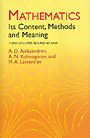
Mathematics: Its Content, Methods and Meaning
Publisher:
Dover Publications
Publication Date:
1999
Number of Pages:
372
Format:
Paperback
Price:
38.95
ISBN:
9780486409163
Category:
Anthology
The Basic Library List Committee strongly recommends this book for acquisition by undergraduate mathematics libraries.
[Reviewed by , on ]
Michael Berg
08/16/2010
Mathematics: Its Content, Methods, and Meaning (Three Volumes Bound as One [!]), by (Can you believe it?) Aleksandrov, Kolmogorov, and Lavrent’ev, is a titanic work, weighing in at 356 + 374 + 351 = 1081 pages. In Part I (in two parts) a it follows a trajectory from general themes in analysis to analytic geometry, the theory of algebraic equations, and ODE. In Part II (also in two parts) we go from PDE through differential geometry, calculus of variations, and complex analysis, then through some prime number theory, probability, to (the perhaps somewhat dissonant theme of) “electronic and computing machines.” Finally, in Part III (yes, in two parts), the parth goes from real variables through linear algebra, non-Euclidean geometry, to (and this is by itself worth the price of admission:) topology (by Aleksandrov), functional analysis (by Gel’fand), and groups and then some (by Mal’cev). Well, the whole book is peppered with Russian (or Soviet — see below) luminaries: Delone, Sobolev, Ladyzenskaya, Postnikov, and Faddeev, to name a few (in addition to the aforementioned).
Thus, the book under review is a compendium of rather beefy survey articles written by long-ball hitters in their fields, playing in the Soviet Union in the late 1950s, well before the empire crumbled. So it is that in the Preface to the Russian Edition the editors state that “the authors have kept in mind the goal of acquainting a sufficiently wide circle of the Soviet intelligentsia with the various mathematical disciplines, their content and methods, the foundations on which they are based, and the paths along which they have developed.” As such it covers a load of serious mathematics, accessible to, say, a strong senior undergraduate with adequate Sitzfleisch — well, presumably the reader can pick and choose: the sections are autonomous and the book’s sections can easily be read excursionally, to coin a phrase.
(About the intended audience of Soviet intelligentsia, is it possible to ignore the image of Krushschev or Kosygin curling up before a warm fire in their dacha’s living room, at the end of another rough day at the Politburo, with a well-thumbed copy of the book under review in hand and a bottle of vodka at the ready? I’m willing to believe the part about the vodka …)
In any event, Party leaders and apparatchiks aside, as far as the book proper is concerned, my favorite part is Part III, where, on, page 30, a cool discussion by Steckin of the Lebesgue integral is given, replete with the y-axis being sliced up, and where (on pp. 227–261) we find I. M. Gel’fand’s essay on functional analysis. Even in a treatment pitched at the present level, the master’s artistic touch cannot be hidden. Perhaps it is precisely under such circumstances that mastery shines through most remarkably. En passant, speaking of Gel’fand’s mastery, I’d recommend to the reader the gorgeous book by Gel’fand, Graev, and Piatetskii-Shapiro, Representation Theory and Automorphic Forms, just for sheer elegance.
Of course, Gel’fand eventually left Russia, as the thaw set in, spending the last decades of his life at Rutgers, and Piatetskii-Shapiro eventually left for Yale and Tel-Aviv. They both died free men in 2009, Gel’fand at 96, Piatetskii-Shapiro at almost 80; God rest their souls. With both of them also being Jews, I am reminded of my own dear senior colleague, Lev Abolnikov, who is also an expatriate Russian Jew. Lev escaped from the USSR many decades ago, when the darkness was severe, and he has horror stories to tell of the regime. He tells me, also, that scientists were obliged in those days to start off their publications with special encomia to the Party and dialectical materialism. And, to be sure, we find on page iii of the book under review the ideological allusion that “[the] abstract character of mathematics gave birth even in antiquity to idealistic notions about its independence of the material world.” Even if that reads as something of an anachronism today, to read anything resembling a paean to the regime that gave us the Gulag is, to put it mildly, jarring. But turning the page, or turning over a new leaf, as one prays Russia has done too, takes us safely to Mathematics proper, and the ensuing thousand pages are, by and large, a treat and a marvelous achievement: even professionals will find a lot in these pages to enjoy and to learn. The authors have provided lists at the end of chapters of suggested further reading: an autodidact’s dream.
Michael Berg is Professor of Mathematics at Loyola Marymount University in Los Angeles, CA.
| Volume 1. Part 1 | |||||||
| Chapter 1. A general view of mathematics (A.D. Aleksandrov) | |||||||
| 1. The characteristic features of mathematics | |||||||
| 2. Arithmetic | |||||||
| 3. Geometry | |||||||
| 4. Arithmetic and geometry | |||||||
| 5. The age of elementary mathematics | |||||||
| 6. Mathematics of variable magnitudes | |||||||
| 7. Contemporary mathematics | |||||||
| Suggested reading | |||||||
| Chapter 2. Analysis (M.A. Lavrent'ev and S.M. Nikol'skii) | |||||||
| 1. Introduction | |||||||
| 2. Function | |||||||
| 3. Limits | |||||||
| 4. Continuous functions | |||||||
| 5. Derivative | |||||||
| 6. Rules for differentiation | |||||||
| 7. Maximum and minimum; investigation of the graphs of functions | |||||||
| 8. Increment and differential of a function | |||||||
| 9. Taylor's formula | |||||||
| 10. Integral | |||||||
| 11. Indefinite integrals; the technique of integration | |||||||
| 12. Functions of several variables | |||||||
| 13. Generalizations of the concept of integral | |||||||
| 14. Series | |||||||
| Suggested reading | |||||||
| Part 2. | |||||||
| Chapter 3. Analytic Geometry (B. N. Delone) | |||||||
| 1. Introduction | |||||||
| 2. Descartes' two fundamental concepts | |||||||
| 3. Elementary problems | |||||||
| 4. Discussion of curves represented by first- and second-degree equations | |||||||
| 5. Descartes' method of solving third- and fourth-degree algebraic equations | |||||||
| 6. Newton's general theory of diameters | |||||||
| 7. Ellipse, hyperbola, and parabola | |||||||
| 8. The reduction of the general second-degree equation to canonical form | |||||||
| 9. The representation of forces, velocities, and accelerations by triples of numbers; theory of vectors | |||||||
| 10. Analytic geometry in space; equations of a surface in space and equations of a curve | |||||||
| 11. Affine and orthogonal transformations | |||||||
| 12. Theory of invariants | |||||||
| 13. Projective geometry | |||||||
| 14. Lorentz transformations | |||||||
| Conclusions; Suggested reading | |||||||
| Chapter 4. Algebra: Theory of algebraic equations (B. N. Delone) | |||||||
| 1. Introduction | |||||||
| 2. Algebraic solution of an equation | |||||||
| 3. The fundamental theorem of algebra | |||||||
| 4. Investigation of the distribution of the roots of a polynomial on the complex plane | |||||||
| 5. Approximate calculation of roots | |||||||
| Suggested reading | |||||||
| Chapter 5. Ordinary differential equations (I. G. Petrovskii) | |||||||
| 1. Introduction | |||||||
| 2. Linear differential equations with constant coefficients | |||||||
| 3. Some general remarks on the formation and solution of differential equations | |||||||
| 4. Geometric interpretation of the problem of integrating differential equations; generalization of the problem | |||||||
| 5. Existence and uniqueness of the solution of a differential equation; approximate solution of equations | |||||||
| 6. Singular points | |||||||
| 7. Qualitative theory of ordinary differential equations | |||||||
| Suggested re | |||||||
| Volume 2 Part 3 | |||||||
| Chapter 6. Partial differential equations (S. L. Sobolev and O. A. Ladyzenskaja) | |||||||
| 1. Introduction | |||||||
| 2. The simplest equations of mathematical physics | |||||||
| 3. Initial-value and boundary-value problems; uniqueness of a solution | |||||||
| 4. The propagation of waves | |||||||
| 5. Methods of constructing solutions | |||||||
| 6. Generalized solutions | |||||||
| Suggested reading | |||||||
| Chapter 7. Curves and surfaces (A. D. Aleksandrov) | |||||||
| 1. Topics and methods in the theory of curves and surfaces | |||||||
| 2. The theory of curves | |||||||
| 3. Basic concepts in the theory of surfaces | |||||||
| 4. Intrinsic geometry and deformation of surfaces | |||||||
| 5. New Developments in the theory of curves and surfaces | |||||||
| Suggested reading | |||||||
| Chapter 8. The calculus of variations (V. I. Krylov) | |||||||
| 1. Introduction | |||||||
| 2. The differential equations of the calculus of variations | |||||||
| 3. Methods of approximate solution of problems in the calculus of variations | |||||||
| Suggested reading | |||||||
| Chapter 9. Functions of a complex variable (M. V. Keldys) | |||||||
| 1. Complex numbers and functions of a complex variable | |||||||
| 2. The connection between functions of a complex variable and the problems of mathematical physics | |||||||
| 3. The connection of functions of a complex variable with geometry | |||||||
| 4. The line integral; Cauchy's formula and its corollaries | |||||||
| 5. Uniqueness properties and analytic continuation | |||||||
| 6. Conclusion | |||||||
| Suggested reading | |||||||
| Part 4. | |||||||
| Chapter 10. Prime numbers (K. K. Mardzanisvili and A. B. Postnikov) | |||||||
| 1. The study of the theory of numbers | |||||||
| 2. The investigation of problems concerning prime numbers | |||||||
| 3. Chebyshev's method | |||||||
| 4. Vinogradov's method | |||||||
| 5. Decomposition of integers into the sum of two squares; complex integers | |||||||
| Suggested reading | |||||||
| Chapter 11. The theory of probability (A. N. Kolmogorov) | |||||||
| 1. The laws of probability | |||||||
| 2. The axioms and basic formulas of the elementary theory of probability | |||||||
| 3. The law of large numbers and limit theorems | |||||||
| 4. Further remarks on the basic concepts of the theory of probability | |||||||
| 5. Deterministic and random processes | |||||||
| 6. Random processes of Markov type | |||||||
| Suggested reading | |||||||
| Chapter 12. Approximations of functions (S. M. Nikol'skii) | |||||||
| 1. Introduction | |||||||
| 2. Interpolation polynomials | |||||||
| 3. Approximation of definite integrals | |||||||
| 4. The Chebyshev concept of best uniform approximation | |||||||
| 5. The Chebyshev polynomials deviating least from zero | |||||||
| 6. The theorem of Weierstrass; the best approximation to a function as related to its properties of differentiability | |||||||
| 7. Fourier series | |||||||
| 8. Approximation in the sense of the mean square | |||||||
| Suggested reading | |||||||
| Chapter 13. Approximation methods and computing techniques (V. I. Kr | |||||||
| 1. Approximation and numerical methods | |||||||
| 2. The simplest auxiliary means of computation | |||||||
| Suggested reading | |||||||
| Chapter 14. Electronic computing machines (S. A. Lebedev and L. V. Kantorovich) | |||||||
| 1. Purposes and basic principles of the operation of electronic computers | |||||||
| 2. Programming and coding for high-speed electronic machines | |||||||
| 3. Technical principles of the various units of a high-speed computing machine | |||||||
| 4. Prospects for the development and use of electronic computing machines | |||||||
| Suggested reading | |||||||
| Volume 3. Part 5. | |||||||
| Chapter 15. Theory of functions of a real variable (S. B. Stechkin) | |||||||
| 1. Introduction | |||||||
| 2. Sets | |||||||
| 3. Real Numbers | |||||||
| 4. Point sets | |||||||
| 5. Measure of sets | |||||||
| 6. The Lebesque integral | |||||||
| Suggested reading | |||||||
| Chapter 16. Linear algebra (D. K. Faddeev) | |||||||
| 1. The scope of linear algebra and its apparatus | |||||||
| 2. Linear spaces | |||||||
| 3. Systems of linear equations | |||||||
| 4. Linear transformations | |||||||
| 5. Quadratic forms | |||||||
| 6. Functions of matrices and some of their applications | |||||||
| Suggested reading | |||||||
| Chapter 17. Non-Euclidean geometry (A. D. Aleksandrov) | |||||||
| 1. History of Euclid's postulate | |||||||
| 2. The solution of Lobachevskii | |||||||
| 3. Lobachevskii geometry | |||||||
| 4. The real meaning of Lobachevskii geometry | |||||||
| 5. The axioms of geometry; their verification in the present case | |||||||
| 6. Separation of independent geometric theories from Euclidean geometry | |||||||
| 7. Many-dimensional spaces | |||||||
| 8. Generalization of the scope of geometry | |||||||
| 9. Riemannian geometry | |||||||
| 10. Abstract geometry and the real space | |||||||
| Suggested reading | |||||||
| Part 6. | |||||||
| Chapter 18. Topology (P. S. Aleksandrov) | |||||||
| 1. The object of topology | |||||||
| 2. Surfaces | |||||||
| 3. Manifolds | |||||||
| 4. The combinatorial method | |||||||
| 5. Vector fields | |||||||
| 6. The development of topology | |||||||
| 7. Metric and topological space | |||||||
| Suggested reading | |||||||
| Chapter 19. Functional analysis (I. M. Gelfand) | |||||||
| 1. n-dimensional space | |||||||
| 2. Hilbert space (Infinite-dimensional space)< | |||||||
| 4. Integral equations | |||||||
| 5. Linear operators and further developments of functional analysis | |||||||
| Suggested reading | |||||||
| Chapter 20. Groups and other algebraic systems (A. I. Malcev) | |||||||
| 1. Introduction | |||||||
| 2. Symmetry and transformations | |||||||
| 3. Groups of transformations | |||||||
| 4. Fedorov groups (crystallographic groups) | |||||||
| 5. Galois groups | |||||||
| 6. Fundamental concepts of the general theory of groups | |||||||
| 7. Continuous groups | |||||||
| 8. Fundamental groups | |||||||
| 9. Representations and characters of g | |||||||
| 10. The general theory of groups | |||||||
| 11. Hypercomplex numbers | |||||||
| 12. Associative algebras | |||||||
| 13. Lie algebras | |||||||
| 14. Rings | |||||||
| 15. Lattices | |||||||
| 16. Other algebraic systems | |||||||
| Suggested reading | |||||||
| Index |
- Log in to post comments