- About MAA
- Membership
- MAA Publications
- Periodicals
- Blogs
- MAA Book Series
- MAA Press (an imprint of the AMS)
- MAA Notes
- MAA Reviews
- Mathematical Communication
- Information for Libraries
- Author Resources
- Advertise with MAA
- Meetings
- Competitions
- Programs
- Communities
- MAA Sections
- SIGMAA
- MAA Connect
- Students
- MAA Awards
- Awards Booklets
- Writing Awards
- Teaching Awards
- Service Awards
- Research Awards
- Lecture Awards
- Putnam Competition Individual and Team Winners
- D. E. Shaw Group AMC 8 Awards & Certificates
- Maryam Mirzakhani AMC 10 A Awards & Certificates
- Two Sigma AMC 10 B Awards & Certificates
- Jane Street AMC 12 A Awards & Certificates
- Akamai AMC 12 B Awards & Certificates
- High School Teachers
- News
You are here
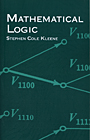
Mathematical Logic
Publisher:
Dover Publications
Publication Date:
2002
Number of Pages:
416
Format:
Paperback
Price:
24.95
ISBN:
9780486425337
Category:
Monograph
The Basic Library List Committee suggests that undergraduate mathematics libraries consider this book for acquisition.
[Reviewed by , on ]
Steven Deckelman
05/23/2016
This is a Dover reprint of Stephen Cole Kleene’s classic book, published originally by John Wiley and Sons in 1967. A pdf scan of the original 1967 version is available on line at the Internet Archive. This presumably means the book is in the public domain.
Kleene (1909–1994), intended this book to be an introduction to mathematical logic at the undergraduate level, in contrast to his earlier and more celebrated Introduction to Metamathematics (1952), which was intended as a graduate text. The older book is often considered to be the better of the two. Indeed, this book contains many references to the older book and some of its parts are actually abridged versions of the older book.
The book is about 400 pages and divided into two parts. The first part introduces elementary mathematical logic, that is, propositional and predicate calculus. The second part delves into logic and the foundations of mathematics (computability, decidablity, formal number theory, Turing machines, incompleteness, completeness etc.). There are many exercises and an extensive bibliography.
Since its appearance fifty years ago there have been myriad other introduction to logic texts published, many of which might be considered more accessible to undergraduates, such as Herbert Enderton’s A Mathematical Introduction to Logic. Nevertheless I find Kleene’s book to still be quite lucid introduction that might work well as a text for honors students.
When a book enters the pantheon of historical classics is not always clear, but certainly the author’s stature as one of the great logicians of the twentieth century makes the book’s exposition interesting in and of itself.
Steven Deckelman is a professor of mathematics at the University of Wisconsin-Stout, where he has been since 1997. He received his Ph.D from the University of Wisconsin-Madison in 1994 for a thesis in several complex variables written under Patrick Ahern. Some of his interests include complex analysis, mathematical biology and the history of mathematics.
|
PART I. ELEMENTARY MATHEMATICAL LOGIC
|
||||||||
| CHAPTER I. THE PROPOSITIONAL CALCULUS | ||||||||
| 1. Linguistic considerations: formulas | ||||||||
| 2. "Model theory: truth tables,validity " | ||||||||
| 3. "Model theory: the substitution rule, a collection of valid formulas" | ||||||||
| 4. Model theory: implication and equivalence | ||||||||
| 5. Model theory: chains of equivalences | ||||||||
| 6. Model theory: duality | ||||||||
| 7. Model theory: valid consequence | ||||||||
| 8. Model theory: condensed truth tables | ||||||||
| 9. Proof theory: provability and deducibility | ||||||||
| 10. Proof theory: the deduction theorem | ||||||||
| 11. "Proof theory: consistency, introduction and elimination rules" | ||||||||
| 12. Proof theory: completeness | ||||||||
| 13. Proof theory: use of derived rules | ||||||||
| 14. Applications to ordinary language: analysis of arguments | ||||||||
| 15. Applications to ordinary language: incompletely stated arguments | ||||||||
| CHAPTER II. THE PREDICATE CALCULUS | ||||||||
| 16. "Linguistic considerations: formulas, free and bound occurrences of variables" | ||||||||
| 17. "Model theory: domains, validity" | ||||||||
| 18. Model theory: basic results on validity | ||||||||
| 19. Model theory: further results on validity | ||||||||
| 20. Model theory: valid consequence | ||||||||
| 21. Proof theory: provability and deducibility | ||||||||
| 22. Proof theory: the deduction theorem | ||||||||
| 23. "Proof theory: consistency, introduction and elimination rules" | ||||||||
| 24. "Proof theory: replacement, chains of equivalences" | ||||||||
| 25. "Proof theory: alterations of quantifiers, prenex form" | ||||||||
| 26. "Applications to ordinary language: sets, Aristotelian categorical forms" | ||||||||
| 27. Applications to ordinary language: more on translating words into symbols | ||||||||
| CHAPTER III. THE PREDICATE CALCULUS WITH EQUALITY | ||||||||
| 28. "Functions, terms" | ||||||||
| 29. Equality | ||||||||
| 30. "Equality vs. equivalence, extensionality" | ||||||||
| 31. Descriptions | ||||||||
| PART II. MATHEMATICAL LOGIC AND THE FOUNDATIONS OF MATHEMATICS | ||||||||
| CHAPTER IV. THE FOUNDATIONS OF MATHEMATICS | ||||||||
| 32. Countable sets | ||||||||
| 33. Cantor's diagonal method | ||||||||
| 34. Abstract sets | ||||||||
| 35. The paradoxes | ||||||||
| 36. Axiomatic thinking vs. intuitive thinking in mathematics | ||||||||
| 37. "Formal systems, metamathematics" | ||||||||
| 38. Formal number theory | ||||||||
| 39. Some other formal systems | ||||||||
| CHAPTER V. COMPUTABILITY AND DECIDABILITY | ||||||||
| 40. Decision and computation procedures | ||||||||
| 41. "Turing machines, Church's thesis" | ||||||||
| 42. Church's theorem (via Turing machines) | ||||||||
| 43. Applications to formal number theory: undecidability (Church) and incompleteness (Gödel's theorem) | ||||||||
| 44. Applications to formal number theory: consistency proofs (Gödel's second theorem) | ||||||||
| 45. "Application to the predicate calculus (Church, Turing)" | ||||||||
| 46. "Degrees of unsolvability (Post), hierarchies (Kleene, Mostowski)." | ||||||||
| 47. Undecidability and incompleteness using only simple consistency (Rosser) | ||||||||
| CHAPTER VI. THE PREDICATE CALCULUS (ADDITIONAL TOPICS) | ||||||||
| 48. Gödel's completeness theorem: introduction | ||||||||
| 49. Gödel's completeness theorem: the basic discovery | ||||||||
| 50. "Gödel's completeness theorem with a Gentzen-type formal system, the Löwenheim-Skolem theorem" | ||||||||
| 51. Gödel's completeness theorem (with a Hilbert-type formal system) | ||||||||
| 52. "Gödel's completeness theorem, and the Löwenheim-Skolem theorem, in the predicate calculus with equality" | ||||||||
| 53. Skolen's paradox and nonstandard models of arithmetic | ||||||||
| 54. Gentzen's theorem | ||||||||
| 55. "Permutability, Herbrand's theorem" | ||||||||
| 56. Craig's interpolation theorem | ||||||||
| 57. "Beth's theorem on definability, Robinson's consistency theorem" | ||||||||
| BIBLIOGRAPHY | ||||||||
| THEOREM AND LEMMA NUMBERS: PAGES | ||||||||
| LIST OF POSTULATES | ||||||||
| SYMBOLS AND NOTATIONS | ||||||||
| INDEX | ||||||||
- Log in to post comments