- About MAA
- Membership
- MAA Publications
- Periodicals
- Blogs
- MAA Book Series
- MAA Press (an imprint of the AMS)
- MAA Notes
- MAA Reviews
- Mathematical Communication
- Information for Libraries
- Author Resources
- Advertise with MAA
- Meetings
- Competitions
- Programs
- Communities
- MAA Sections
- SIGMAA
- MAA Connect
- Students
- MAA Awards
- Awards Booklets
- Writing Awards
- Teaching Awards
- Service Awards
- Research Awards
- Lecture Awards
- Putnam Competition Individual and Team Winners
- D. E. Shaw Group AMC 8 Awards & Certificates
- Maryam Mirzakhani AMC 10 A Awards & Certificates
- Two Sigma AMC 10 B Awards & Certificates
- Jane Street AMC 12 A Awards & Certificates
- Akamai AMC 12 B Awards & Certificates
- High School Teachers
- News
You are here
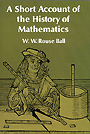
A Short Account of the History of Mathematics
Publisher:
Dover Publications
Publication Date:
1960
Number of Pages:
522
Format:
Paperback
Price:
18.95
ISBN:
9780486206301
Category:
Monograph
The Basic Library List Committee suggests that undergraduate mathematics libraries consider this book for acquisition.
[Reviewed by , on ]
Michael Berg
07/7/2011
How can a 500 page book lay claim to be a “short account” of anything? Well, if we consider the sweep of mathematics through recorded history, it starts to look like a reasonable appellation, especially if we factor in that the author is a Victorian don from Trinity College, Cambridge, i.e., a scholar from the old school, when academic publications did not appear at a pace and in such numbers as to boggle the mind of even the narrow specialist. Consider in this connection, for example, that a Google search for “history of mathematics” yields on the order of 16,800,000 hits: enough to make a Victorian don take up … well, how about beekeeping?
Anyway, the book under review, suggestively titled A Short Account of the History of Mathematics, being the Dover rendering of the 1908 fourth edition of this book, whose first edition appeared two decades earlier, is an example of both scholarship and pedagogy of an age gone by.
The first edition was substantially a transcript of some lectures which I [W. W. Rouse Ball, the author] delivered in the year 1888 with the object of giving a sketch of the history, previous to the nineteenth century, that should be intelligible to any one acquainted with the elements of mathematics. In the second edition, issued in 1893, I rearranged parts of it, and introduced a good deal of additional matter.
Well, this is actually an understatement: the new “scheme of arrangement,” as WWRB puts it in his Preface, engenders a split of the 500 pages of the book into a first half devoted to the era up to and including the Renaissance, with the remaining 250 pages or so devoted to the history of the subject from Huygens and Descartes through the 19th century. In fact, this second half, titled “Third Period. Modern Mathematics,” is really worth the price of admission in its own right (and, given that we’re dealing with Dover, it’s a steal!), in that it includes as its last chapter an appraisal of the mathematics of the 19th century done at its close, by a major scholar in the history of the discipline: it doesn’t get any better than that!
Specifically, Chapter XIX starts with a survey of number theory with Gauss, Dirichlet, Eisenstein, Smith, and Kummer; proceeds to automorphic functions (“Development of the Theory of Functions of Multiple Periodicity”) featuring Abel, Jacobi, and Riemann; then goes to the theory of functions and “Higher Algebra” with Cauchy, Hamilton, Grassmann, Galois, Cayley and Sylvester, Lie, and Hermite. And there’s more: “Synthetic Geometry” (where we meet Steiner and von Staudt), non-Euclidean geometry, and then, in proper 19th century British style, a good deal of applied mathematics. (Where’s Dedekind? Well, he does appear, but doesn’t get headline billing: perhaps this just underscores the fact that in certain major ways he was really a 20th century figure.)
Now, in point of fact, WWRB’s 19th chapter weighs in at less than 60 pages! How does one cram this many players’ contributions into such a compact orbit? Well, it’s a “short account,” after all, and we find, e.g., the following on Galois in toto:
A new development of algebra — the theory groups of substitutions — was suggested by Evariste Galois, who promised to be one of the most original mathematicians of the nineteenth century, born at Paris on October 26, 1811, and killed in a duel on May 30, 1832, at the early age of 20. The theory of groups, and of invariant subgroups, has profoundly modified the treatment of the theory of equations. An immense literature has grown up on the subject. The modern theory of groups originated with the treatment by Galois, Cauchy, and J. A. Serret (1819–1885), professor at Paris; their work is mainly concerned with finite discontinuous substitution groups. This line of investigation has been pursues by M.E. C.Jordan (1838-1922) of Paris and E. Netto of Strasbourg. The problem of operations with discontinuous groups, with applications to the theory of functions, has been further taken up by (among others) F. G.Frobenius of Berlin, F. C. Klein of Göttingen, and W. Burnside formerly of Cambridge and now of Greenwich.
Taking this entry as an exemplar, we can easily infer one of the proper uses for the book under review in today’s university classroom: it could obviously serve as a source book of sketches for more expansive treatments done elsewhere, e.g. in such texts as Boyer-Merzbach or Katz.
However, there’s much more to WWRB’s Short Account than that. The earlier eighteen chapters of the book correspond, after all, to the author’s Cambridge lectures on the subject and, accordingly, are much more than telegraphic sketches: consider, for instance, that the 16th chapter is devoted to Newton, and the 17th to Leibniz and “the mathematicians of the first half of the eighteenth century.” Obviously today’s professor faced with pre-19th century material to present to his history class can do a great deal, building on what Rouse Ball presents here. To be sure, we do not encounter as many worked out examples and specially devised problem sets in these pages as we’d find in more recent books, but we do find a marvelous scholarly discussion of themes of major interest. (And WWRB does present us with various interesting illustrations; consider, e.g. his marvellous discussion of Archimedes’ quadrature of the parabola on pp. 67–70, in the dozen page subsection of Chapter 4 devoted to Archimedes.)
Thus, A Short Account of the History of Mathematics is a treasure trove for a number of reasons. It certainly serves two roles in connection with our classroom work in the subject: wonderful renderings of some of the older themes, and good sketches of the 19th century material. Indeed, as one marches back in time, leafing through the book’s pages, the amount of detail the author includes seems to increase proportionally. Well, it can’t really be otherwise for a historian, I suppose.
In addition it is worth noting that the book is in its own way somewhat encyclopædic: Chapter 1 covers Egypt and Phoenicia; “First Period” covers the Greeks and their considerable influence; “”Second Period” deals with the Middle Ages and the Renaissance; “Third Period” is suggestively titled “Modern Mathematics.” This clearly displays the high quality of Rose Ball’s scholarship and illustrates the persistent utility of the book in today’s Mathematics departments. A Short Account of the History of Mathematics should serve well as a supplementary text in any history of mathematics course — like the one I am teaching in the Fall.
Michael Berg is Professor of Mathematics at Loyola Marymount University in Los Angeles, CA.
| PREFACE | |||||||
| TABLE OF CONTENTS | |||||||
| CHAPTER I. EGYPTIAN AND PHOENICIAN MATHEMATICS. | |||||||
| The history of mathematics begins with that of the Ionian Greeks | |||||||
| Greek indebtedness to Egyptians and Phoenicians | |||||||
| Knowledge of the science of numbers possessed by the Phoenicians | |||||||
| Knowledge of the science of numbers possessed by the Egyptians | |||||||
| Knowledge of the science of geometry possessed by Egyptians | |||||||
| Note on ignorance of mathematics shewn by the Chinese | |||||||
| First Period. Mathematics under Greek Influence. | |||||||
| CHAPTER II. THE IONIAN AND PYTHAGOREAN SCHOOLS. | |||||||
| Authorities | |||||||
| The Ionian School | |||||||
| "THALES, 640-550 B.C." | |||||||
| His geometrical discoveries | |||||||
| His astronomical teaching | |||||||
| Anaximander. Anaximenes. Mamercus. Mandryatus | |||||||
| The Pythagorean School | |||||||
| "PYTHAGORAS, 569-500 B.C." | |||||||
| The Pythagorean teaching | |||||||
| The Pythagorean geometry | |||||||
| The Pythagorean theory of numbers | |||||||
| Epicharmus. Hippasus. Phiololaus. Archippus. Lysis | |||||||
| "ARCHYTAS, circ. 400 B.C." | |||||||
| His solution of the duplication of a cube | |||||||
| Theodorus. Timaeus. Bryso | |||||||
| Other Greek Mathematical Schools in the Fifth Century B.C. | |||||||
| Oenopides of Chios | |||||||
| Zeno of Elea. Democritus of Abdera | |||||||
| CHAPTER III. THE SCHOOLS OF ATHENS AND CYZICUS. | |||||||
| Authorities | |||||||
| Mathematical teachers at Athens prior to 420 B.C. | |||||||
| Anaxogoras. The Sophists. Hippias (The quadratrix) | |||||||
| Antipho | |||||||
| Three problems in which these schools were specially interested | |||||||
| "HIPPOCRATES of Chios, circ. 420 B.C." | |||||||
| Letters used to describe geometrical diagrams | |||||||
| Introduction in geometry of the method of reduction | |||||||
| The quadrature of certain lunes | |||||||
| The problem of the duplication of the cube | |||||||
| "Plato, 429-348 B.C." | |||||||
| Introduction in geometry of the method of analysis | |||||||
| Theorem on the duplication of the cube | |||||||
| "EUDOXUS, 408-355 B.C." | |||||||
| Theorems on the golden section | |||||||
| Introduction of the method of exhaustions | |||||||
| Pupils of Plato and Eudoxus | |||||||
| "MENAECHMUS, circ. 340 B.C." | |||||||
| Discussion of the conic selections | |||||||
| His two solutions of the duplication of the cube | |||||||
| Aristaeus. Theaetetus | |||||||
| "Aristotle, 384-322 B.C." | |||||||
| Questions on mechanics. Letters used to indicate magnitudes | |||||||
| CHAPTER IV. THE FIRST ALEXANDRIAN SCHOOL | |||||||
| Authorities | |||||||
| Foundation of Alexandria | |||||||
| The Third Century before Christ | |||||||
| "EUCLID, circ. 330-275 B.C." | |||||||
| Euclid's Elements | |||||||
| The Elements as a text-book of geo | |||||||
| The Elements as a text-book of the theory of numbers | |||||||
| Euclid's other works | |||||||
| "Aristarchus, circ. 310-250 B.C." | |||||||
| Method of determining the distance of the sun | |||||||
| Conon. Dositheus. Zeuxippus. Nicoteles | |||||||
| "ARCHIMEDES, 287-212 B.C." | |||||||
| His works on plane geometry | |||||||
| His works on geometry of three dimensions | |||||||
| "His two papers on arithmetic, and the "cattle problem" | |||||||
| His works on the statistics of solids and fluids | |||||||
| His astronomy | |||||||
| The principles of geometry and that of Archimedes | |||||||
| "APOLLONIUS, circ. 260-200 B.C." | |||||||
| His conic sections | |||||||
| His other works | |||||||
| His solution of the duplication of a cube | |||||||
| Contrast between his geometry and that of Archimedes | |||||||
| "Erathosthenes, 275-194 B.C." | |||||||
| The Sieve of Eratosthenes | |||||||
| The Second Century before Christ | |||||||
| "Hypsicles (Euclid, book XIV). Nicomedes. Diocles" | |||||||
| Perseus. Zejodorus | |||||||
| "HIPPARCHUS, circ. 130 B.C." | |||||||
| Foundation of scientific astronomy | |||||||
| Foundation of trigonometry | |||||||
| "HERO of Alexandria, circ. 125 B.C." | |||||||
| Foundation of scientific engineering and of land-surveying | |||||||
| Area of a triangle determined in terms of its sides | |||||||
| Features of Hero's works | |||||||
| The First Century before Christ | |||||||
| Theodosius | |||||||
| Dionysodorus | |||||||
| End of the First Alexandrian School | |||||||
| Egypt constituted a Roman province | |||||||
| CHAPTER V. THE SECOND ALEXANDRIAN SCHOOL | |||||||
| Authorities | |||||||
| The First Century after Christ | |||||||
| Serenus. Menelaus | |||||||
| Nicomachus | |||||||
| Introduction of the arithmetic current in medieval Europe | |||||||
| The Second Century after Christ | |||||||
| Theon of Smyran. Thymaridas | |||||||
| "PTOLEMY, died in 168" | |||||||
| The Almagest | |||||||
| Ptolemy's astronomy | |||||||
| Ptolemy's geometry | |||||||
| The Third Century after Christ | |||||||
| "Pappus, circ. 280" | |||||||
| "The Suagwg?, a synopsis of Greek mathematics" | |||||||
| The Fourth Century after Christ | |||||||
| Metrodorus. Elementary problems in arithmetic and algebra | |||||||
| Three stages in the development of algebra | |||||||
| "DIOPHANTUS, circ. 320 (?)" | |||||||
| Introduction of syncopated algebra in his Arithmetic | |||||||
| "The notation, methods, and subject-matter of the work" | |||||||
| His Porisms | |||||||
| Subsequent neglect of his discoveries | |||||||
| Iamblichus | |||||||
| Theon of Alexandria. Hypatia | |||||||
| Hostility of the Eastern Church to Greek science | |||||||
| The Athenian School (in the Fifth Century) | |||||||
| "Proclus, 412-485. Damascius. Euto | |||||||
| Roman Mathematics | |||||||
| Nature and extent of the mathematics read at Rome | |||||||
| Contrast between the conditions at Rome and at Alexandria | |||||||
| End of the Second Alexandrian School | |||||||
| "The capture of Alexandria, and end of the Alexandrian Schools" | |||||||
| CHAPTER VI. THE BYZANTINE SCHOOL. | |||||||
| Preservation of works of the great Greek Mathematicians | |||||||
| Hero of Constantinople. Psellus. Planudes. Barlaam. Argyrus | |||||||
| Nicholas Rhabdas. Pachymeres. Moschopulus (Magic Squares) | |||||||
| "Capture of Constantinople, and dispersal of Greek Mathematicians" | |||||||
| CHAPTER VII. SYSTEMS OF NUMERATION AND PRIMITIVE ARITHMETIC. | |||||||
| Authorities | |||||||
| Methods of counting and indicating numbers amoung primitive races | |||||||
| Use of the abacus or swan-pan for practical calculation | |||||||
| Methods of representing nu | |||||||
| The Lilavati or arithmetic ; decimal numeration used | |||||||
| The Bija Ganita or algebra | |||||||
| Development of Mathematics in Arabia | |||||||
| "ALKARISMI or AL-KHWARIZMI, circ. 830" | |||||||
| His Al-gebr we 'l mukabala | |||||||
| His solution of a quadratic equation | |||||||
| Introduction of Arabic or Indian system of numeration | |||||||
| "TABIT IBN KORRA, 836-901 ; solution of a cubic equation" | |||||||
| Alkayami. Alkarki. Development of algebra | |||||||
| Albategni. Albuzjani. Development of trigonometry | |||||||
| Alhazen. Abd-al-gehl. Development of geometry | |||||||
| Characteristics of the Arabian School | |||||||
| CHAPTER X. INTRODUCTION OF ARABIAN WORKS INTO EUROPE. | |||||||
| The Eleventh Century | |||||||
| Moorish Teachers. Geber ibn Aphla. Arzachel | |||||||
| The Twelfth Century | |||||||
| Adelhard of Bath | |||||||
| Ben-Ezra. Gerad. John Hispalensis | |||||||
| The Thirteenth Century | |||||||
| "LEONARDO OF PISA, circ. 1175-1230" | |||||||
| "The Liber Abaci, 1202" | |||||||
| The introduction of the Arabic numerals into commerceThe introduction of the Arabic numerals into science | |||||||
| The mathematic tournament | |||||||
| "Frederick II., 1194-1250" | |||||||
| "JORDANUS, circ. 1220" | |||||||
| His De Numeris Datis ; syncopated algebra | |||||||
| Holywood | |||||||
| "ROGER BACON, 1214-1294" | |||||||
| Campanus | |||||||
| The Fourteenth Century | |||||||
| Bradwardine | |||||||
| Oresmus | |||||||
| The reform of the university curriculum | |||||||
| The Fifteenth Century | |||||||
| Beldomandi | |||||||
| CHAPTER XI. THE DEVELOPMENT OF ARITHMETIC. | |||||||
| Authorities | |||||||
| The Boethian arithmetic | |||||||
| Algorism or modern arithmetic | |||||||
| The Arabic (or Indian) symbols : history of | |||||||
| "Introduction into Europe by science, commerce, and calendars" | |||||||
| Improvements introduced in algoristic arithmetic | |||||||
| (I) Simplification of the fundemental processe | |||||||
| (ii) Introduction of signs for addition and subtra | |||||||
| (iii) "Invention of logarithms, 1614" | |||||||
| (iv) "Use of decimals, 1619" | |||||||
| CHAPTER XII. THE MATHEMATICS OF THE RENAISSANCE. | |||||||
| Authorities | |||||||
| Effect of invention of printing. The renaissance | |||||||
| Development of Syncopated Algebra and Trigonometry | |||||||
| "REGIOMONTANUS, 1436-1476" | |||||||
| His De Triangulis (printed in 1496) | |||||||
| "Purbach, 1423-1461. Cusa, 1401-1464. Chuquet, circ. 1484" | |||||||
| Introduction and origin of symbols + and - | |||||||
| "Pacioli or Lucas di Burgo, circ. 1500" | |||||||
| "His arithmetic and geometry, 1494" | |||||||
| "Leonardo da Vinci, 1452-1519" | |||||||
| "Dürer, 1471-1528. Copernicus, 1473-1543" | |||||||
| "Record, 1510-1588 ; introduction of symbol for equality" | |||||||
| "Rudolff, circ. 1525. Riese, 1489-1559" | |||||||
| "STIFEL, 1486-1567" | |||||||
| "His Arithmetica Integra, 1544" | |||||||
| "TARTAGLIA, 1500-1559" | |||||||
| "His solution of a cubic equation, 1535" | |||||||
| "His arithmetic, 1556-1560" | |||||||
| "CARDAN, 1501-1576" | |||||||
| "Hid Ars Magna, 1545 ; the third work printed on algebra" | |||||||
| His solution of a cubic equation | |||||||
| "Ferrari, 1522-1565 ; solution of a biquadratic equation" | |||||||
| "Rheticus, 1514-1576. Maurolycus. Borrel. Xylander" | |||||||
| "Commandino. Peletier. Romanus. Pitiscus. Ramus, 1515-1572" | |||||||
| "Bombelli, circ. 1570" | |||||||
| Development of Symbolic Algebra | |||||||
| "VIETA, 1540-1603" | |||||||
| "The In Artem ; introduction of symbolic algebra, 1591" | |||||||
| Vieta's other works | |||||||
| "Girard, 1590-1633 ; development of trigonometry and algebra" | |||||||
| "NAPIER, 1550-1617 ; development of trigonometry and algebra" | |||||||
| "Briggs, 1556-1631 ; calculations of tables of logarithms" | |||||||
| "HARRIOT, 1560-1621 ; development of analysis in algebra" | |||||||
| "Oughtred, 1574-1660" | |||||||
| The Origin of the more Common Symbols in Algebra | |||||||
| CHAPTER XIII. THE CLOSE OF THE RENAISSANCE. | |||||||
| Authorities | |||||||
| Development of Mechanics and Experimental Methods | |||||||
| "STEVINUS, 1548-1620" | |||||||
| "Commencement of the modern treatment of statistics, 1586" | |||||||
| "GALILEO, 1564-1642" | |||||||
| Commencement of the science of dynamics | |||||||
| Galileo's astronomy | |||||||
| "Francis Bacon, 1561-1626" | |||||||
| Revival of Interest in Pure Geometry | |||||||
| "KEPLER, 1571-1630" | |||||||
| "His Paralipomena, 1604 ; principle of continuity" | |||||||
| "His Stereometria, 1615 ; use of infinitesimals" | |||||||
| "Kepler's laws of planetary motion, 1609 and 1619" | |||||||
| "Desargues, 1593-1662" | |||||||
| His Brouillon project ; use of projective geometry | |||||||
| Mathematical Knowledge at the Close of the Renaissance | |||||||
| Third Period. Modern Mathematics | |||||||
| CHAPTER XIV. THE HISTORY OF MODERN MATHEMATICS. | |||||||
| Treatment of the subject | |||||||
| Invention of analytical geometry and the method of indivis | |||||||
| Invention of the calculus | |||||||
| Development of mechanics | |||||||
| Application of mathematics to physics | |||||||
| Recent development of pure mathematics | |||||||
| CHAPTER XV. HISTORY OF MATHEMATICS FROM DESCARTES TO HUYGENS. | |||||||
| Authorities | |||||||
| "DESCARTES, 1596-1650" | |||||||
| His views on philosophy | |||||||
| "His invention of analytical geometry, 1637" | |||||||
| "His algebra, optics, and theory of vortices" | |||||||
| "CAVALIERI, 1598-1647" | |||||||
| The method of indivisibles | |||||||
| "PASCAL, 1623-1662" | |||||||
| His geometrical conics | |||||||
| The arthmetical triangle | |||||||
| "Foundation of the theory of probabilities, 1654" | |||||||
| His discussion of the cycloid | |||||||
| "WALLIS, 1616-1703" | |||||||
| "The Arithmetica Infinitorum, 1656" | |||||||
| Law of indices in algebra | |||||||
| Use of series in quadratures | |||||||
| "Earliest rectification of curves, 1657" | |||||||
| Wallis's algebra | |||||||
| "FERMAT, 1601-1665" | |||||||
| His investigation on the theory of numbers | |||||||
| His use in geometry of analysis and of infinitesimals | |||||||
| "Foundation of the theory of probabilities, 1654" | |||||||
| "HUYGENS, 1629-1695" | |||||||
| "The Horologium Oscillatorium, 1673" | |||||||
| The undulatory theory of light | |||||||
| Other Mathematicians of this Time | |||||||
| Bachet | |||||||
| Marsenne ; theorem on primes and perfect numbers | |||||||
| Roberval. Van Schooten. Saint-Vincent | |||||||
| Torricelli. Hudde. Frénicle | |||||||
| De Laloubère. Mercator. Barrow ; the differential triangle | |||||||
| Brouncker ; continued fractions | |||||||
| James Gregory ; distinction between convergent and divergent series | |||||||
| Sir Christopher Wren | |||||||
| Hooke. Collins | |||||||
| Pell. Sluze. Viviani | |||||||
| Tschirnhausen. De la Hire. Roemer. Rolle. | |||||||
| CHAPTER XVI. THE LIFE AND WORKS OF NEWTON. | |||||||
| Authorities | |||||||
| Newton's school and undergraduate life | |||||||
| "Investigations in 1665-1666 on fluxions, optics, and gravitation" | |||||||
| "His views on gravitation, 1666" | |||||||
| Researches in 1667-1669 | |||||||
| "Elected Lucasian professor, 1669" | |||||||
| "Optical lectures and discoveries, 1669-1671" | |||||||
| "Emission theory of light, 1675" | |||||||
| "The Leibnitz Letters, 1676" | |||||||
| "Discoveries and lectures on algebra, 1673-1683" | |||||||
| "Discoveries and lectures on gravitation, 1684" | |||||||
| "The Principia, 1685-1686" | |||||||
| The subject-matter of the Principia | |||||||
| Publication of the Principia | |||||||
| Investigations and work from 1686 to 1696 | |||||||
| "Appointment at the Mint, and removal to London, 1696" | |||||||
| "Publication of the Optics, 1704" | |||||||
| Appendix on classification of cubic curves | |||||||
| Appendix on quadrature by | |||||||
| The controversy as t |
- Log in to post comments